


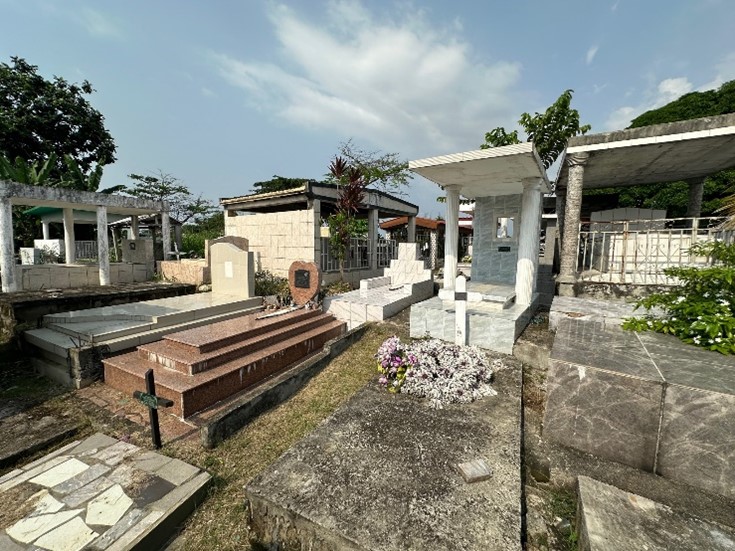
Pictures taken in 2024

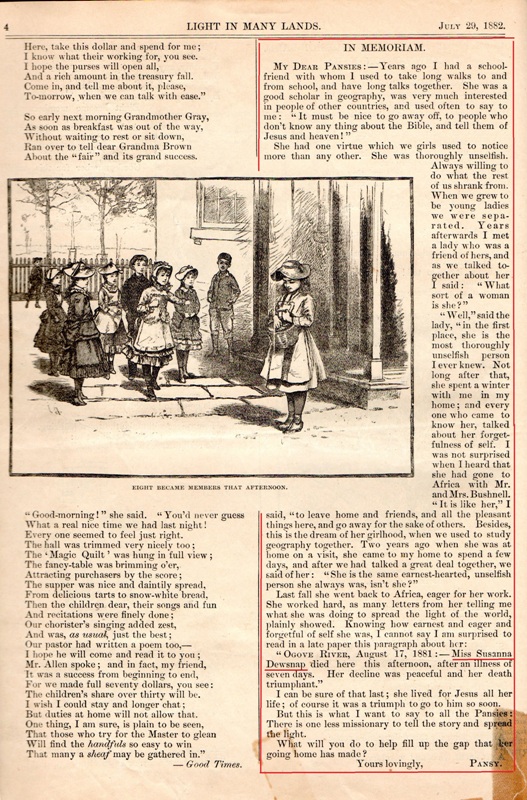
Susannah Dewsnap was born in 1840 to George Dewsnap, b. 1814 in Woodstock, Oxfordshire, England, and Susannah (Gatfield) b. 1819 in New York. Susanna had five brothers, George, Mark, William, Price and Samuel, along with three sisters, Mitilda, Charlotte and Mary Jane. Susanna had been a student at the Johnstown Academy near Albany, NY.
Her paternal grandparents were George Dewsnap, b. Aug. 1783 in Woodstock, Oxfordshire, England, d. Oct 1837, and Mary Ann Pates, b. Aug 1791 in Bicestor, Oxford, England. They immigrated to the United States around 1832. They had a total of nine children. Susanna’s great grandparents would be Joseph Dewsnap, b. abt 1740 , d. Aug 1812 in Woodstock, Oxfordshire, England, and Ann Du-Bois. Susanna’s great-great-grand parents would be John Dewsnap, b Dec 1717 in Crosse Cliffe, Derbyshire, England, d. May 1777 in Glossup, Derbyshire, England, and Martha Morly. Susanna’s great-great-great grandparents would be Robert Dewsnap of Derbyshire, England, d. 1773, and Mary Dearnelly.
————————————-
Susanna became a missionary and traveled to Africa where she died as a result of “African Fever” in Libreville Gabon Africa. She served at the Baraka Mission – located in present day downtown Libreville, near the ocean. Kangwe Mission was several day’s boat journey away. One had to travel south along the coast, and enter the Ogowe River. If you look at a current map of Gabon, this is now Lambarene. This mission later became the site of Schweitzer Hospital. Missionaries had the habit of referring to Baraka station as ‘Gaboon’ because of the Gaboon River.
Peter Menkel was the mission boat captain and handyman/builder. He married black American missionary Charity Sneed. She died a year after Susanna Dewsnap, and her gravestone is right next to hers.
Dear Ms. Terrell,
I stumbled across your genealogy website today after Googling the name of Susannah Dewsnap. I did so after reading this account of the book Trader Horn here http://www.cynicalreflections.net/2013/11/a-philosophy-of-trampingtrader-horn.html. This author cites a book by South African author/historian Tim Couzens called ‘Tramp Royal’ that is a biography of Trader Horn (real name Aloysius Smith) who wrote the Trader Horn books with Ethelreda Lewis in the late 1920s. I read this book years ago, but had forgotten these details.
Are you aware that Susannah Dewsnap is obviously the woman identified in Trader Horn as ‘Miss Haskins’? Aloysius Smith (Horn is a pen name) took her body from Kangwe to Baraka in his small steamboat, (the Pioneer). She made a big impression on the young man – he talks repeatedly about her bravery and spirit in the book. The diary of the Miss Campbell does not mention who brought her body to Baraka, but Aloysius himself describes attending the ceremony and burial.
I just wanted to make sure you knew that your ancestor/relative was mentioned in this bestselling book from the 1920s! The 1930 movie Trader Horn departs from the story in the book. In the movie a Mrs. Haskins dies on the river, but she is the mother of Nina, a white girl kept as a priestess in a native village.
I have been to Gabon many times. Next time I go to Libreville, I very much want to see the grave and stone you have pictured.
Sincerely,
from
Ithaca, New York
Notes from Laura Kreis Campbell
FOR MY EYES ONLY –
[note: Laura and her husband Graham served at Baraka from 1881 until circa 1888 this is her personal journal kept during their first year there. I’m including excerpts that mention Susanna Dewsnap]
Sunday eve. Feb. 27th 1881
The Mpongwe also came in from the trip up the Ogowe. We had a good letter from Dr. Bacheler, also a short one from Miss Dewsnap. They have been in great need of food and quinine. They are not provided for as well as they should be. Chances for sending are not frequent and Mr. Walker often forgets to order what they need. Dr. B. sent up a coop of chickens by the Mpongwe. We are very glad to get them. Mr. Walker is not well today, he has a slight touch of fever. Mrs. Bushnell is also feeling badly. I am real well and hope to continue so.
Friday June 3rd 1881
We are disappointed in our visit to Kângwe. Miss Dewsnap went yesterday in a steam launch which does not return to Gaboon [Baraka Mission]. If there had been an opportunity of coming back soon Graham would have gone.
Ogovi River
Saturday Eve June 4, 1881
Yesterday morning very unexpectedly to us the “Mpongwe” [ Mission’s boat] started for Kangwe. Although we heard that it was going a half an hour before she started we got ready, put a few things in a truck and reached the ship just as the Capt. did. He said he would take us to the Kangwe, so here we are about halfway up. We passed the steam launch last evening at least we supposed we must have as she has not gone by the towns where we has stopped. If we had overtaken it near enough we should have taken in Miss Dewsnap. It is quite laughable that we shall be there to welcome her to Kangwe she we said good bye to her at Gaboon [Baraka Mission]. The mosquitoes are too thick for writing.
On Deck of the Mpongwe
Sunday June 5th
We are getting pretty well up to Kangwe. If we don’t land on a land bank will reach there at seven this evening. Just saw two large monkeys in a tree, the first wild ones I have seen. The scenery is very nice, splendid trees and running vines everywhere. Have passed several large towns. The mate says that there is one more sand bar which if we cross we will have no more trouble. Will probably not stay in Kangwe more than two days. Have seen nothing of the steam launch. Am sorry for Miss Dewsnap. The captain is not well today. The mate takes the lead well even better than the Capt. himself. We are both well.
Can plainly see two large Pelicans. Their bills are fully half as big as their bodies. Saw the heads of several Hippopotimi this morning. Hope to see the whole body when we get farther up. Wild Parrots are flying about in large flocks. Wish Harry could see them.
Later – half‑past four p.m.
We have just met a part of County de Braza’s crew, about thirty five canoes containing some 500 people. Two white men are among them. They quite swarm the river and stand in their canoes looking “with all their eyes.” They are going to meet Dr. _________ who is in the steam launch behind us.
Now we are passing the first Pangwe towns.
Tuesday, June 7th
On Board The “Mpongwe”
We landed at the German Factory about seven Sun. evening. Mr. Shiff sent us to Kângwe in a canoe a distance of about four miles. What a surprise it was to the missionaries! They could hardly believe it was really us. We walked in the room while they were at evening meeting. One and all welcomed us very cordially. Dr. Bacheler looks like quite an old man but is not quite as old as my husband, although he might be taken for his father, as far as his years appear. The Dr. is not well and was planning to come to visit us to rest and breathe sea air. So we persuaded him to return with us. He left Mr. Reading in charge, and Mrs. Reading will be company for Mrs. Bacheler. We were quite surprised to find that the Bachelers expect an increase in their family in three months. We are very glad for them. Mrs. B. has been as well as possible so far she says, and is very cheerful and happy. She has her sewing all done and showed me her things. They are very cunning. Mrs. R. has been most kind and helpful.
Yesterday we talked almost incessantly. Went about the hill, saw their garden, heard their plans for new buildings, etc., etc.
The Readings expect to build at ______________ not far from the present station. They will have Sunday service together and schools separate.
We found the hill very difficult to climb but once up it is a beautiful spot. They have a very small house now, but are building a large school house and will have several sleeping rooms in it. We occupied Miss Dewsnap’s room. Poor Lady! She has not arrived yet, neither have we yet met her on our way down. She must be all tired out. Hope nothing serious has happened. Will feel easier when we get to Angôla where we think they must be. Have stuck on no sand bars yet.
The gentlemen have had several shots at hippopotami this afternoon. I saw several quite distinctly. We saw a chimpansee at Kângwe. It is a horrible looking animal and look too much like man to suit me. It cries like an angry child. G. would have bought it if I had consented, but I didn’t want to have so unpleasant an animal about, knew that our boys would make it cross and ugly.
The school at Kângwe is not large, more boys than girls. And what girls there are are all betroths of boys there. There are some advantages in that plan, for they receive the same training and will be more helpful to each other in the future. It is quite sad to see educated young men obliged to marry ignorant, heathen women. They are sure to have an evil influence of course.
It is only a little after six P.M. We are making excellent time going down the river, but they expect to stop one day at Angôla much to my discomfort.
Friday, June 10th
We are at home again and met with a most cordial welcome. All were surprised to see the Doctor and glad too. Found everything just as we left it. Miss Walker was here and had the house open to receive us. Lita and Ayumi came to meet us as well as many of the boys and several of the men and women came to the house.
We have enjoyed our visit so much. God has been very good to us, and has been present with us.
Thursday, Aug. 31st [1881]
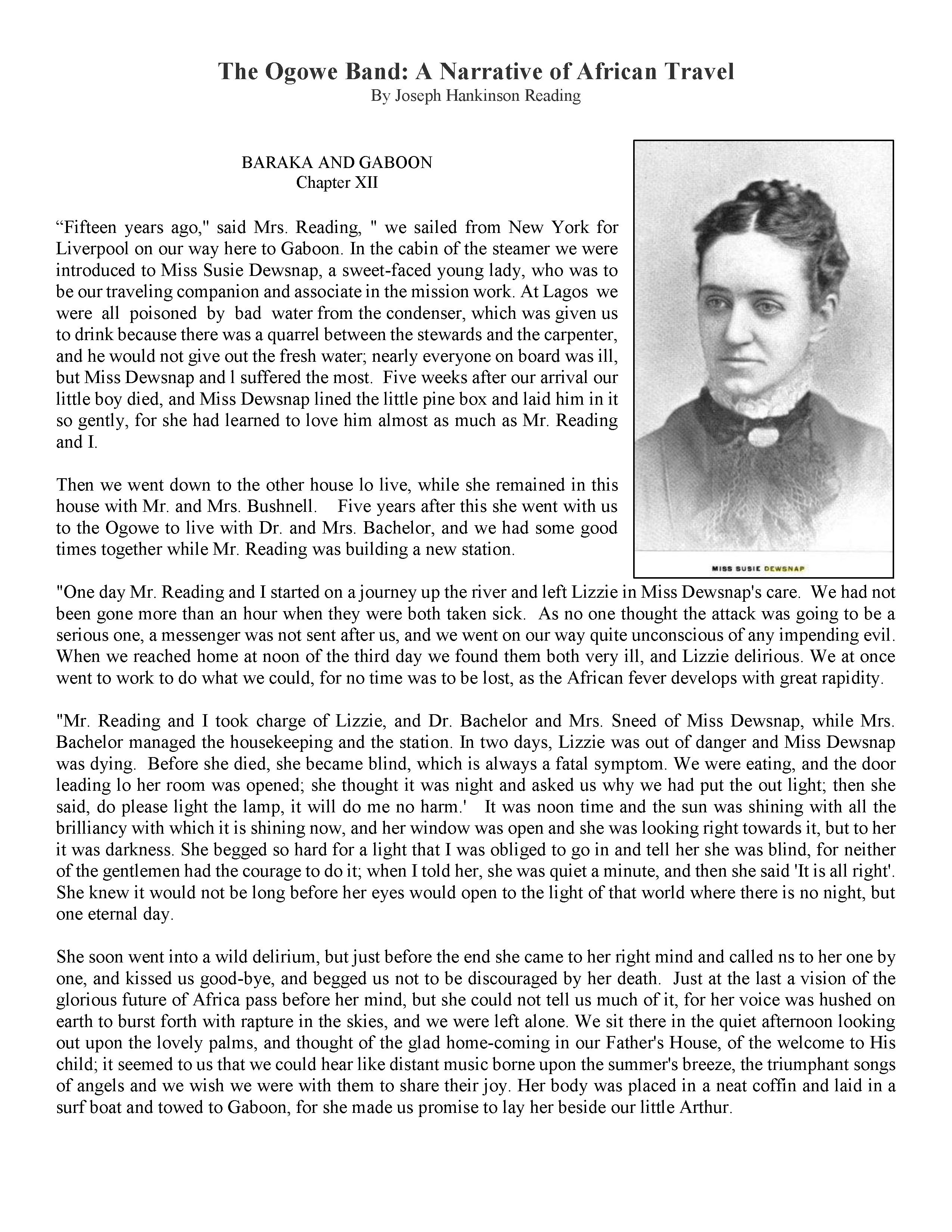
Much has occurred since I last wrote, both sad and joyous events. The most sorrowful one of all is the illness and death of our dear sister Miss. Dewsnap, which occurred a short time ago. She was sick with malignant fever one week, and died Aug. 17th. Was unconscious most of the time during her illness, but the day before she died her reason was restored to her, and she gave some directions about her property, and bade them all good bye. Her remains were brought to Gaboon in a steam launch sent for that purpose by one of the Eng. traders. On account of the illness of Lizzie Reading, and the soon expected confinement of Mrs. Bacheler, neither of the gentlemen could come to Gaboon on the launch. The first intimation we had of Miss Dewsnap’s death was on Sabbath afternoon when a native woman came rushing in our rooms saying “Miss. Dewsnap is dead.” “Miss. Dewsnap is dead.” It was a great shock to us all. Her remains were then on our beach, and Graham immediately went down and had them brought up. We buried her in our little burying ground as soon as possible for she had been dead four days, but inclosed in a double coffin with charcoal between them. The funeral services were held just without our little graveyard under the shade of our beautiful trees. There was a large attendance of both natives and European traders. Mr. Walker spoke in Mpongwe and Mr. Marling in English. Mr. Campbell conducted the burial service. It was such sudden news to us all that we did not realize our loss. It seemed and still seems more like a dream to us. But we shall miss her more and more as time advances. The Kangwe people must be very weary and lonely now. My husband and I felt that it was his duty to go up and help them a few weeks., for if Mrs. Bacheler should be very ill (but we hope for the best) they would be in great need of help. So this morning Graham is just staring on the steam launch for Kangwe. He has said “good bye” and gone on board but they have not yet started. I could hardly let him go much as I want him to for their sake; but he will be obliged to be away at least a month and perhaps six weeks before he will have an opportunity to return. The steamers cannot go up the Ogowe until the rains commence, which time is very uncertain. If he has to wait too long he will come over land which is only two days journey to the Remwe where our native preacher Ntaka Truman is, from there he can come by boat.
Here are some more notes on Susanna…the book “MY OGOWE” was written by Dr Robert Hamill Nassau, who served with the mission for forty years. His sister, Isabella Nassau, also served for nearly that long. She died and was buried at the northern mission station, Batanga, in 1905. They were colleagues of Susanna Dewsnap.
Mary
Notes from My Ogowe (Robert Hamill Nassau) which mention Miss Dewsnap
1) Page 87¼Baraka Mission Station, July 1875. Nassau mentions death of little Arthur Reading. Single missionaries Miss ( Lydia ) Jones, Miss Lush and Miss Dewsnap helped arrange the coffin.
[Note: Miss Dewsnap later worked alongside the Readings in Kangwe, after their return from furlough in the US ]
2) p.127‑132…January 1876 Annual Mission Mtg. Nassau mentions traveling from Benita Station with his sister Bella and Miss Jones, visiting De Heers on Corisco Island and landing at Baraka. He lists the mission ladies: Mrs. (Lucina) Bushnell, Miss (Bella) Nassau , Miss ( Lydia ) Jones, Miss (J.M.) Lush, Miss Dewsnap. A short time later, Miss Lush marries a Baptist missionary named Mr. Smith. They served in Viktoria, Kameroon. In June of 1876, Miss Dewsnap visited them there.
Nassau went on furlough in 1880. When he returned in Dec. 1881, he noted that Miss Dewsnap had died. Also mentions that Mrs (J. M. Lush) Smith had returned to the US with consumption, and that she never fully recovered.
[Note: Mrs. Smith went first to England to recuperate, and then sent word in July 1881 that she would continue on the US , rather than return to Gabon . About that time, Misses Lydia Jones and Lydia Walker also left Gaboon for the US , for health reasons. Miss Dewsnap died just four weeks after their departurea huge loss of single women on the field!]
For a time, Miss Dewsnap served at Benita Mission with Isabella Nassau, Lydia Jones, and the Menkel family. Peter Menkel was the mission boat captain and handyman/builder. He married black‑American missionary Charity Sneed. She died a year after Susanna Dewsnap, and her gravestone is right next to hers (to the right, as you face them).
 Keeper of the Family
Good morning
I am of Gabonese nationality. My wife is a descendant of the Ntoko family (misspelled by the missionaries as “Ntaka”). I am looking for the names of the wife and children of “Ntaka”. If you have this information, it would be very useful to me.
THANKS
LikeLiked by 1 person
Sorry I do not have any other information but wish you the very best of luck in finding the descendants.
LikeLike