
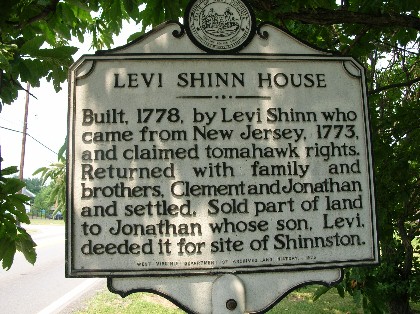
This two story structure built in 1778 is still standing in Shinnston, West Virginia. Levi and his eldest son, Clement, raised two families consisting of 17 children. It has a central fireplace that’s big enough to roast a small herd of pigs. The original house is still there, the only addition is a ‘modern’ kitchen added in the late 1930’s or early 40’s. The Shinn memorabilia – furniture and clothing items, are displayed in the two rooms on the main floor.


Each year the Shinn Kin have an annual picnic at the Homestead. For information on how to become a member of the Shinnston Historical Association, you can call 304-584-4071.

By Lena Golden and Jack Sandy Anderson
Among Harrison County’s early settlers was Levi Shinn (1748-1807), who came to the West Fork Valley with his brother, Jonathan, in the fall of 1772. He was born and grew to manhood near Burlington, New Jersey.
Burlington was where his great grandparents, John and Jane Shinn, had settled upon their arrival from England in or about 1678.
Levi Shinn’s grandfather, James Shinn, married Abigail Lippincott in 1697, thereby allying himself with a prominent and influential family that was actively involved in the affairs of colonial New Jersey. In 1740, Levi’s father, Clement Shinn, married Elizabeth, daughter of Robert Webb, and to them were born seven children. Four of these children — Clement, Levi, Jonathan and David — became Harrison County pioneers, although David eventually settled in Hampshire County and there ended his days.
In 1772, Levi married Elizabeth (1755-1813), daughter of James and Mary Capon Smith and half-sister of Aaron Smith, a noted Simpson Creek pioneer. A family tradition has it that soon after his marriage, he set out to explore what was then the wilderness of western Virginia for the purpose of choosing land upon which he could establish a home. In the West Fork Valley in 1773, he found this land, and on this tract he built a two-story log home that is now one of West Virginia’s few remaining from the Revolutionary War era.
Details about the original Shinn settlement are rather vague, but the best available evidence indicates that Shinn established a permanent home there sometime between 1775 and 1778. It’s known that he and Elizabeth lived for a while on Apple Pie Ridge, a region not far from Winchester, Virginia, and it’s generally assumed they came from there to present Shinnston. At any rate, by 1778, the log house had been built, and the Shinns were busy at work clearing their land and struggling for survival in a rich, but often hostile wilderness.
A man above the ordinary, Shinn soon became a leader in his part of the country. Records and tradition alike reveal him to have been an educated, frugal, and honest individual who in later life was able to amass what was then a considerable fortune. His neighbors frequently sought his counsel, and he was always ready to help those in need.
Although reared in a strickt Quaker household, Shinn soon discovered that Quaker tenets had to be abandoned if he were to survive on the frontier, where death from Indian attack was ever a possibility. Bearing arms was a necessity, and in the 1770s and 1780s, he helped protect the frontier by assisting in the building of fortifications and by responding to alarms that warned of immediate danger. Some of his descendants believed that he served in the militia during the years of Indian warefare, but thus far, no authentic record has been found to prove this.
In or before 1785, Shinn built a gristmill a short distance from the mouth of Shinn’s Run. This mill proved to be of importance, since it formed the nucleus around which grew the village that gradually developed into today’s city of Shinnston. Milling was necessary in early times and seems to have run in the family, for the immigrant ancestor, John Shinn, was a miller in colonial New Jersey and at least three of Levi’s sons at one time or another were engaged in milling.
His extensive lands mostly obtained by grant, included some of the choicest acreage in northern Harrison County and provided a goodly inheritance for his children. However, in 1793, he sold the valuable tract upon which the main section of the town and of East Shinnston today stand. His brothers, Clement and Jonathan, were the purchasers, and it was the latter’s heirs who caused the land to be laid off into lots and sold, thereby laying the foundation for a town. Levi had obtained this tract of over 600 acres in 1784 as part of a preemption warrant he had for 1000 acres. His original tract containing his farm and home was acquired in 1773 and constisted of about 400 acres. Another large tract he onwed was to the west on the waters of Bingamon Creek, and it was upon this tract tha tthe village of Pine Bluff developed.
Tradition tells us that Levi was an unusually strong individual and spent hours working on his farm and in his mill. He was well known for his honest and for his generosity to people in need. Both he and his wife were hopitable by nature, and their home was always open to relatives and friends. For the most part, Shinn chose to live quietly and unassumingly and was not active in the political life of the county. Shinn and his wife, Elizabeth, had nine children who grew up in the Harrison County area. He was a member of the Simpson Creek Baptist Church. In 1807, with his family around him, he died and was buried in the family cemetery in Shinnston.
In time, Shinn’s oldest chiled, Clement (1773-1840), gained possession of the original log house. An industrious person, he managed with care his inheritance, added to it, and died a well-to-do man. Most of his wealth came from milling and raising livestock.
Following Clement’s death and some complicated legal transactions, his heirs sold the log house to David Morris, whose descendants owned it until the mid 1900s. By the 1840s, when this sale occurred, the pioneer era in the West Fork Valley was over, the log houses had become decidedly old-fashioned. Frame dwellings of planed lumber, often large and elaborate, and red brick “mansions,” as they were called in ante-bellum days, were fast replacing them. A quirk of fate is the fact that trhough the marriage of David Morris’s great-granddaughter, Mabel Fleming, to one of Levi Shinn’s great-great-grandsons, Claude S Randall, the log house once more passed into possession of a descendant of its builder. In 1959, Estelle Randall and her brother, George, children and legal heirs of Claude and Mabel Flemming Randall, sold the Levi Shinn House to Richardson Lumber & Construction Co. In 1972, the company deeded the house as a gift to the Shinnston Historical Association, which now owns it and employs it as a headquarters and museum. The Levi Shinn House, which is one of West Virginia’s oldest houses, was entered on the National Register of Historic Places in 1973.
 Keeper of the Family
Please, we want to visit the house on July 9th. Can we talk with someone about this?
724 852 1728
My brother, first cousin and I ( direct descendants of Levi)
LikeLike
levi shin is one of my great gr grandfathers, also I have a grandmother who was an everson who came from that area
LikeLiked by 1 person
levi shinn is my 5th great grandfather, aaron shinn is my 4th great grandfather, and eliza shinn is my third great grandmother, eliza married john bogard, and their daughter phebe bogard m benjamin powell, my grand mother olga fay powell (matheny) is how I am related down thur the line, after research I found that the direct ancestor is john shene of the house of schene, norfolk england 1475 and his ancestor was alan schene of the house of schene 1276
LikeLiked by 1 person
Nice to meet you cousin! Thanks for filling in more of the blanks! I hail from Clement and Mary (Thompson) Shinn – their daughter Olive married a Cunningham, who married a Phelan who married my dad 🙂
LikeLike
I would like to become a lifetime member of the Shinnston Historical Assoc. I have written a check for 100.00. Where do I mail it to? Thanks!
Rob Newbrough
LikeLike
Hi Rob … boy I had to hunt for some info on your membership request but I think this link can help you – https://www.bizapedia.com/wv/shinnston-historical-association-inc.html Best of Luck!
LikeLike
Thanks! That is just what I needed. Rob
>
LikeLiked by 1 person
Thanks for sharing all the great story Mary Jo … I wish I had more to add to it, but maybe others will – fingers crossed!
LikeLike
Hello,
I am a direct descendant of Thomas Atkensen Shinn who is the younger brother of Clement Shinn. They were sons of John Shinn Sr.
A son of Thomas was Samuel Stockton Shinn-his son was Benjamin Uriel Shinn-his son was Josiah Carlock Shinn-his son was Josiah Hazen Shinn-his son was Ezra Hickman Shinn-His son was Zeller Hazen Shinn (my great grandfather) who was a U.S. soldier stationed in the Phillippines and married my filipina great grandmother Joaquina Ignacio. Their son-John Ignacio Shinn was my grandfather. He married my grandmother Lourdes Atilano and had 10 children. He was also allied with American forces against the Japanese and was captured but eventually escaped. He died prematurely leaving my grandmother a widow and ten children without a father. However, because he was already the son of an American soldier (Zeller Hazen Shinn), my father and the whole family approached the Embassy in the Phillippines and the whole family was able to migrate to America in the late 1960s as U.S. citizens.
Zeller Hazen Shinn was honorably discharged and is buried in the Presidio in San Francisco, Ca.
My grandmother and grandfather John Ignacio Shinn had 10 children along with 36 grandchildren. Most of us currently live in Los Angeles California.
i am very grateful that the ancestry of the Shinn Family can be traced back.
Well wishes,
John Joseph Shinn✌️
LikeLike
I am a descendant of Levi Shinn as well thru Clement Shinn, then Seth, Luther, Arthur, and then my grandfather Thurston Arthur Shinn, Jr.! Let me know if you need more details! Love from Los Angeles. I was born Denise Michele Shinn.
LikeLiked by 1 person
I need to think about my questions. I came from the offshoot that was Aaron Shinn who married Mary Pigott and the whole bunch is buried in the cemetery at the Pigott church and cemetery. My grandmother lived with her husband Davis Smith up the hill behind that church. The more I dig the more it seems almost like Walton’s mountain as there is so much family all around that whole geological foundation. As I said I will have more questions when I have some time to think. — I think the story was that Aaron Shinn moved over a bit from Shinnston because there was a problem with cattle thieves. I need to find where that is in writing. One of my family members told me that and I would like to document it so that I could put it on my ancestry file.
LikeLiked by 1 person
By the way I live up in Oregon. I was in Los Angeles for awhile in the 80’s and Denver before that but the oil market crashed and “you couldn’t buy a job in Denver”.
LikeLiked by 1 person
David Randall, from Midland, Tx. My grandfather was Charles Franklin Randall.
He is kin to Shinns, Piggots, you name ’em. His son, Charles, II moved to Hernando, Ms., then with family to Carlsbad, NM. Estelle Randall was one of the remaining Randall’s in the area. Big statue of a soldier in the cemetery is one of the family/Any Randalls left around the area?
LikeLiked by 1 person
You might try doing your part of the family on ancestry.com. I found it incredibly valuable and then combined it with other information I found other places. – My grandmother was a Shinn and she lived in the area by the Pigott church and cemetery. You probably could find relatives buried there after you do your ancestry.com. They give you 10 days free or so it used to be but it wasn’t expensive and you can close it out and still get back in to look at all your work.
LikeLiked by 1 person
Thanks for stopping by and leaving family info David!!
LikeLike
I have a small 2 drawer cabinet made by Jeremiah Shinn in 1837. Given to his daughter Sarah Shinn Randall in 1866 in Shinnston. It was 129 years old when my Mother, Nelle Randall Wife of Charles Franklin Randall, II, gave it to my wife and I in 1966, when we were married. It was handmade bu Jeremiah and it has his inscription on the underside of the lower shelf. A beautiful handmade piece.
LikeLiked by 1 person
Wow! What a treasure!!!
LikeLike
I was doing my genealogy and found that Levi Shinn was my 6th great grandfather on my moms side, Clement being 5th. My grandma was Marjorie Shinn who died in Mich in 1979. My grandpa had always talked about how there where family that where very well known. My family is mainly from Michigan and I live in Florida. Fun stuff to learn and pass down. I’d liked to get up there one day
LikeLiked by 1 person
Nice to meet you cousin! Thanks for sharing your family with us!!
LikeLike
Hi cousins (and others)! I’m from a branch that grew back together! Both Jonathan and Clement were my 5th great grandfathers, and Levi was my 6th great uncle. From Jonathan and Clement, Levi and Hepzibah (respectively) had Luke M > William Elmore > Clyde Hamilton > Archie Neil > William Neil > me. I have only visited twice, most recently was for the dedication of the new family monument at the cemetery just down the road from the cabin.
LikeLiked by 1 person
Well that is quite a linage Clyde!! Fun story – thanks for sharing it. Welcome aboard “our site”!!
LikeLike
Thanks for the work on the Shinn family. My connection to the area is via my ALLEN line. I’m sure that the Allens and Shins knew each other both in NJ (Lambertsville area I believe) and later on. My 5g-gf, Joshua Barnes Allen (b. 1728) is said to have lived in the Apple Pie Ridge area near Winchester and then came to what is now Hepzibah, WV, with his only son, Joshua Barnes Allen, Jr., to take his land grant in 1771.
There’s a family story that Native Americans burned down J. Barnes Allen, Jr’s cabin in the 1780s and he, his wife and children escaped northward to the Levi Shin house.
Cheers!
Mike Shafer
Latrobe, PA
LikeLiked by 1 person
Thanks Mike for stopping by and sharing stories! Always love meeting new cousins!! Uhmmmm … Apple Pie Ridge, sounds so yummy! Love the name!
LikeLike
I married into the Shinn family in 2007. My husband actually took his mom’s maiden name due to unfortunate circumstances. Anyway my husbands grandparents were Kenneth Shinn and grandma was Charolette Wisdom. I figured that my husband was related to Levi because he said how he heard that his ancestors settled Shinnston wv. He still has relatives in the mountains of Virginia but I don’t know their names. Does anyone know anything about this family? Thanks
LikeLiked by 1 person
Thanks for stopping by … I’m hoping others have some answers to your questions –
LikeLike