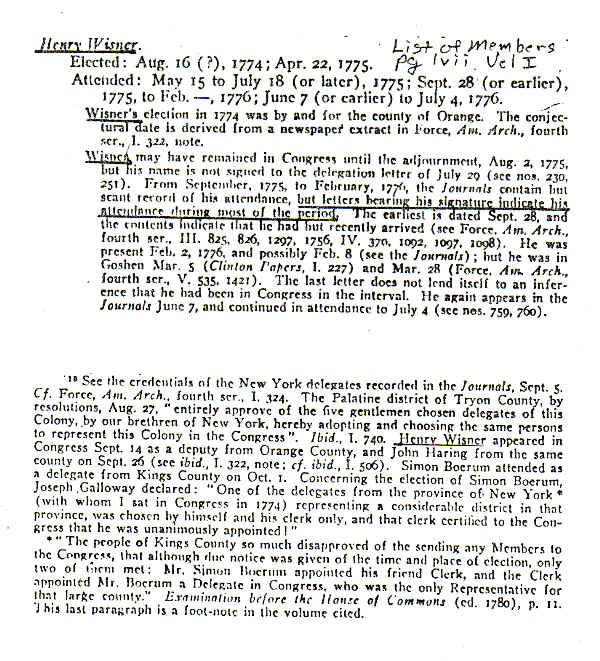
|
Henry Wisner and the Declaration of Independence
Monday, May 12,
2008
http://geoffwisner.blogspot.com/2008/05/henry-wisner-and-declaration-of.html
Henry Wisner was a tall man, vigorous and erect even in old age. Like
his neighbors, he had little learning, but had natural abilities and
pleasing address, and was appointed justice of the peace. He married,
probably about 1740, Sarah Norton, of Queen’s county, and received with
her a farm there. He owned a few slaves and considerable land about
Goshen. His house was a mile south of the village, on the Florida road.
It was a stone house, but is no longer standing. It is said to have once
entertained George Washington and Baron Steuben. Wisner was prominent in
the boundary war between New Jersey and Orange country, and in 1754 it
seems there was a company of Jerseymen formed to take him and Colonel De
Kay “dead or alive.” Wisner served in the New York Colonial Assembly
from 1759 to 1769. The only Bill of any interest introduced by him was
on December 12, 1759, to enable himself, John Alsop, John Morin Scott,
John Van Courtlandt and Joseph Sacket, part proprietors of the patent of
Wawayanda, to sell enough of the undivided land to obtain 1500 pounds to
be applied in draining the Drowned Lands. They were an extensive cedar
marsh annually submerged by the rise of the Wallkill. Drainage has since
largely rendered them capable of cultivation to the profit and health of
the inhabitants.... Wisner strenuously espoused the side of Colonial
rights and warmly opposed the pretensions of the English Parliament.
Rivington’s Tory paper (in 1781) put “old Wisner” among the “tyrants”
and “unfeeling malefactors” of whom the Loyalists complained the
highest. On August 15, 1774, Orange county chose Wisner and [John]
Haring to attend the Continental Congress, then about to be held in
Philadelphia, to concert measures of resistance to British aggressions.
The Congress began in Carpenter’s Hall on September 5, but Wisner did
not take his seat until the fourteenth.... The Second Continental
Congress met in Independence Hall, Philadelphia, May 10, 1775, but
Wisner did not appear until the fifteenth. He was not a prominent member
of this body, but took part in its patriotic measures, including the
wonderfully fortunate selection of a commander-in-chief of the American
armies. Wisner’s attention was early directed to a humble but very
important subject, of which, in a letter dated Philadelphia, December
21, 1775, he writes: “Having for many months been seriously affected
with the great disadvantage the colonies labor under for want of
ammunition, I thought it my duty to apply myself to the attainment of
those necessary arts of making saltpetre and gunpowder, and having far
exceeded my expectations in both manufactures, I think myself further
obliged to communicate the so much needed knowledge to my country at
large.”... He was otherwise serviceable to the patriotic cause by having
spears and gun flints made, and by repairing roads in Orange county by
which provisions and other necessaries were transported to the American
army. He also attended to collecting lead and to the manufacture of
salt, and to fortifying the Hudson against the passage of the British
vessels.
Burdge then takes up the question of whether Wisner and the other
members of the New York delegation to the Second Continental Congress
voted for independence, and if so, why their names did not appear on the
Declaration. The delegates wrote home for instructions on June 8, 1776,
and were apparently told they had no authority to vote for a break with
England. In a second letter dated July 2, 1776, the delegates said they
intended to refrain from voting, but a postscript showed that events had
overtaken them:
It is probable that this letter was written by Wisner, as he sent it to
the New York Provincial Congress with a note of his own saying: “Since
writing the inclosed, the question of Independence has been put in
Congress and carried in the affirmative without one dissenting vote.”
This means [Burdge comments] that no colony voted against it, but that
on July 2, 12 colonies, acting for 13, resolved that the united colonies
are free and independent states. This then is the genuine national
birthday.... Now we have neglected testimony of the intelligent and
honorable Thomas McKean, a Delaware member present on July 4, that Henry
Wisner voted for Independence. It is contained in four letters, one
dated September 26, 1796, and printed in Sanderson’s Biographs, another
dated August 22, 1813, and lithographed in Brotherhead’s Book of the
Signers, a third dated January, 1814, and printed in volume 10 of John
Adam’s Works, and a fourth dated June 16, 1817, and printed in the
appendix to Christopher Marshall’s diary.... It is discreditable that
there is no monument or other record bearing the names of the voters of
Independence. The so-called signers of the Declaration are members of
the Congress after August 2, who were then required to commit themselves
to the cause. On July 4, about 12 of them were not at the Congress, and
two and probably more of them, refused to vote for Independence. These
14 gentlemen have had immortality given them by the carelessness of
history, to the exclusion of Henry Wisner, who better deserves it.
Wisner’s duties called him to New York, (July 12) before the Declaration
of Independence was engrossed on parchment and ready for signing, but he
continued an unattending member of the Continental Congress until May
13, 1777, when a new delegation was elected by New York.
Posted by
Geoff Wisner
at
6:54 AM
Enoch Wisner said...
My name is Enoch Wisner, direct descendant (6 generations removed) from
Henry. My grandfather, John Horner Wisner, Jr.(1879 - 1974), who may be
found among the tables at the back of Wisners in America, is buried in
the family plot, next to Henry, in Goshen. You may trace my line,
through John Horner Wisner, Jr., to Henry, through his son, Lt. Col.
Gabriel Wisner, who died at the battle of Minisink. My brother, Ron
Wisner, has a coin silver letter opener, given to Henry by Ben Franklin,
inscribed with the date, 1776. Also in my brother's possession is a
genealogy, commissioned by J.H. Wisner, Sr., our great-grandfather,
tracing the Wisner and Horner lines to the 15th century, including
several head-stone rubbings, taken in England, of certain other notable
ancestors.
You may have noted that my grandfather lived nearly 100 years. If you
check the dates of my grandfather's grandfather, and his grandfather,
you will see that these lives endured long enough that each grandchild
might well have known his grandfather well. I was born in 1958, and knew
my grandfather very well, having spent much of my time in his houses in
Summit, NJ, and Marion, MA, after my father died in 1969. It is a
peculiar distinction that I can claim - and prove - to have heard of
this country's founding, third-hand.
I'f you're interested in sharing your own line to Henry, or to ask
questions or share something Wisner-related, you may contact me at,
dryrunfarm@comcast.net.
Enoch
November 12, 2008 3:31 AM

|