from 1636 Settler of Hartford, Connecticut and His Descendants
George Graves was one of the original proprietors, of Hartford, Conn., where he settled about 1636,, on the south side of Elm St. about opposite the Daniel’s Mill. A sketch map showing the south-side plantation portion of Hartford in 1636 (map shown on next page) shows Deacon George Graves’ house lot situated on the Little River between the lots of Governor Edward Hopkins and Stephen Post. He was a weaver, in comfortable circumstances, and was appointed to inspect linen and woolen goods for the Colony at Hartford 3 June 1644,. He was chosen “Townsman”, as the Selectmen were then called, in 1650
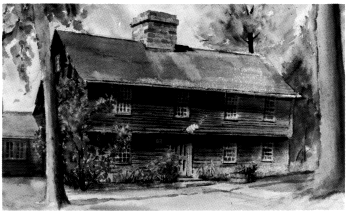
Painting of Deacon John Grave House at Tuxis Farm
and 1668,. He was Deputy to the General Court (Assembly) in 1657 and 1658,, and fence viewer in 1666.
He was married first in England,, and his two eldest children were born there and brought to America by their father. He secondly married widow Sarah Ventres,, mother-in-law of his son George,.
He was against the “withdrawers” from the First Church of Hartford in 1658, but afterwards on Feb. 22, 1670, when the Second Church was organized, he was one of the founders and the first Deacon of the new Church,. The Second Church was organized, as a result of baptismal and synodical controversy, by a group of 31 members of the First Church, under the leadership of the then senior minister, Rev. Whiting. George’s wife, Sarah, was also an original member of the new Church.
Of his second wife it was said (in the Hartford Courant, Feb. 15, 1896) in a sketch of the three prominent women who united with the Church at that time, viz. Sarah Ensign, Sarah Graves, and Margaret Nash, “that she was a sincere Christian Woman who loved her church and whose simple service was a delight and joy, and the legacy of her influence and character helped to mould the belief for the next generation.”
The inventory of the estate of George Graves indicated a value of 278 pounds, 13s, 2d,. His will dated at Hartford 17 Sept. 1673, specified that his lands should “pay their rates according to their proportion, to the maintenance of the ministree at the new meeting house”. He mentions his wife Sarah, sons George and John, son-in-law Jonathan Deming, daughter Mary Dow, and granddaughter Priscilla Markham.

His will follows:
I, George Grave of Hartford, upon the River of Conecticutt, weaver, doe in this my Last Will & Testament give unto Sarah my wife all my houseing & Barne, orchards, Home Lott, Meadow Land, Swamp Land & upland, & whatever is in my house, for her to make use of during the time of her Life, and after her decease to be disposed of as followeth: I doe also hereby give unto my sonn John Grave one parcell of meadow Land Lying in the south meadow between Mr. Richards Land & Mr. Whitings Land, which peice of Land is by estimation allmost Three Acres. I doe also hereby give unto my son John Grave one parcell of Swamp Land Lying by the Land called the forty Acres, in the south meadow, Between Mr. Goodwins Land and Tho: Catlins Land, which parcell of Land is by estimation Two Acres & a halfe, both which parcells of Land are for him to injoy forever after the death of my wife. I doe also hereby give unto my sonn-in-law Jonathan Deming my Two Cowes, for him to injoy after my decease. I dow also give unto my daughter Mary Dow the sume of Tenn pounds, to be paid to her forty shillings in every yeare until the Ten pounds be discharged, next after my decease. I doe also hereby give unto my daughter Mary Dowe my great Brass pott & pott hooks, & also one feather Bed & Feather Bowlster, & one green Blankett, & one Pillow & two pillow beirs, for her to injoy after my wive’s decease. I doe allso hereby give unto my granddaughter Priscilla Markham my least brass pott & pott hooks, & my Iron Kettle, & two of my best platters, a bigger & a lesser. I doe allso hereby give unto priscilla Marcum one Flock bed & one Bowlster, for her to Injoy after the death of my wife. I dow allso hereby give unto my sonn George Grave my house, Barne & Home Lott, orchards & all other of my Lands both meadow, Swamp & upland, Except what is before given away, to him during the time of his life & to his heirs forever, for him to possess after the death of my wife. I doe allso hereby give unto my sonn George Grave (my debts & the Legacies being payd) my Cattell, my household stuffe & what ever els is mine or due to me from any one, for him to possess & injoy forever, after the death of my wife. My will also is that all my Land shall pay their rates, according to their proportion, to the Maintenance of the Ministree at the new meeting house. My will and desire is that my sonn George Grave should take my Estate into his hands & custodie, & the care of my wife, his mother-in-law, & see that shee bee Comfortably provided for during the time of her life, she now not being in a fitt capacittie to help her selfe in this way. Also, if more than ordinary charges should arise by reason of any Long sickness that should attend her, that then the whole estate should share in the Charge that ariseth. Allso my will is that all the Lining that shall remayn after my wifes decease, which is not given before, shall be equally divided between my son George’s wife & my daughter Dowe. I doe also hereby make my two sons George Grave & John Grave my Executors of this my last will & Testament. In witness whereof I have hereunto set my hand.
Witness: John Richards George Grave, Sen.
Steven Hopkins
Court Record, page 134, 25 Nov. 1673, Will proven.
The planning for the movement of some of the people of Newtown (later Cambridge), MA, to found Hartford began prior to May 15, 1634. On this date the General Court gave them permission “to seeke out some convenient place,” promising to confirm it to them, provided the place chosen was not prejudiced to any plantation already settled.
According to Winthrop’s journal, under the date of Oct. 15, 1635: “About sixty men, women and little children, went by land toward Connecticut with their cows, horses, and swine, and, after a tedious and difficult journey, arrived safe there.” This apparently referred to the first group of settlers in Hartford (previously called Suckiaug by the Indians). Nearly half of this pioneer company from Newtown were recent arrivals from England. They arrived at their destination toward the end of October, their journey taking about two weeks. Thirteen men of this group returned to Newtown in November, having stayed in Hartford long enough to claim house lots and help the new settlers get established.
A sketch showing the north-side plantation house lots of these first settlers is on the next page. The road from Little River to the north meadow was the precursor of present day Front Street. The road from the Palisado to Centinel Hill is now Main Street.
The first group of settlers, led by Thomas Hooker (picture on page 18), left Newtown on Tuesday, May 31, 1636. Many were from Newtown, but others came from other Massachusetts towns, or soon after their arrival from England. The location of his house lot indicates that George Grave arrived in 1636, but it is not known where he came from or exactly when in 1636.
The settlers in 1636 did not make their way through an unmarked, trackless wilderness with only their compass to guide them, as has been stated by some writers. They followed a beaten path, already trodden that season by several other companies with cattle. The path led from Newtown on the north bank of the Charles River, through Watertown, Waltham, Weston, Wayland and Framingham, passing north of Cochituate Pond. Then it turned southward through the present borders of South Framingham, Ashland, Hopkinton and Westborough to Grafton. Then it crossed the Blackstone River, and went through the present town of Milbury, through Charlton to Sturbridge. From there it went through Fiskdale and Agawam, to Springfield. The route was then down the Connecticut River, crossing the river at the ferry at Windsor, finally arriving in Hartford.
At least many of the 1636 settlers were granted lands in the south-side plantation, as shown on the map on page 12.
The original “writeing” in which Sequassen and his tribe conveyed the Suckiaug lands to Samuel Stone and William Goodwin in 1636 specified “all the land from Wethersfield bounds on the south to Windsor bounds on the north, and the whole bredth from Connecticutt river on the east six large miles into the wilderness on the west.” The grant was later renewed and enlarged.
for more Graves History
 Keeper of the Family