By Allen Packwood
Allen Packwood explains how the grandson of a Duke came to represent an industrial neighbor of Manchester
Churchill’s links with the town of Oldham began in the summer of 1899 when he was approached by the local Conservative Party and asked to stand as a Tory candidate in the impending by-election. At first glance he appears a strange choice. He was certainly not a local man. In fact, it would be fair to say that his roots were both geographically and socially far removed from the industrial North-West.
Winston Leonard Spencer Churchill, born at Blenheim Palace to the second son of a Duke, was brought up by a nanny in large houses full of servants. His education was typical of the Victorian aristocrat, passing from private boarding schools to Harrow and then to Sandhurst. He did not excel at all of his studies. His early school reports make for entertaining reading. His first headmaster described him as “a constant trouble to everybody…always in some scrape or other” and, on another occasion, opined (with notable lack of prescience) that he lacked ambition.
But by 1899 Churchill did have two things going for him. The first was the reputation of his father. Lord Randolph Churchill’s glittering political career had been cut short by illness, and he had died in 1895 aged only 45. But at the height of his powers in the early 1880s Lord Randolph had been famous for his wit and fiery speeches. It was Lord Randolph who conceived of appealing for support of the Conservative Party to ordinary working classes under the slogan of “Tory Democracy.” Although he never really defined what Tory Democracy actually was, it ensured that he was remembered fondly in places like Oldham, where his speeches had been well received.
Young Winston’s second advantage by 1899 was his own rapidly developing reputation. Although only in his twenties he was already master of the art of self-promotion. On leaving Sandhurst he had joined the army as a cavalry officer, but it was never his intention to remain in uniform for long. He wanted to “forge his sword into a despatch box” and enter the world of politics. In order to do this he needed to make both money and a name for himself. His solution was to transfer himself to as many danger spots as possible and then to publish his experiences as newspaper articles and books.
In 1895 he had used his army leave to travel to Cuba and observe at first hand the uprising against the Spanish authorities. Here he came under fire for the first time. His adventures were serialised in the Daily Graphic newspaper. In the winter of 1896-97 he fought on the North West Indian frontier. This led to a mention in despatches and to his first book, The Story of the Malakand Field Force. In 1898 he popped up with General Kitchener’s expeditionary force in the Sudan and took part in the famous cavalry charge against the Dervishes at the Battle of Omdurman. Inevitably, this escapade spawned another book, The River War. All of this literary activity provided him with an income and, perhaps more importantly, with publicity.
Churchill’s candidature at Oldham was very much a marriage of convenience. A “young man in a hurry,” he was desperate to follow in his famous father’s footsteps. And the Conservative Party in Oldham was keen to field a candidate with the Churchill name and family connections.
At the end of the last century the borough of Oldham still returned two MPs to Parliament. At the previous election the town had returned two Conservatives, Robert Ascroft and James Oswald. The by-election of 1899 had been brought about as a result of an unfortunate set of circumstances. Ascroft had died suddenly and Oswald had resigned because of ill health, thereby leading to a contest for both seats. Churchill’s “running mate” from the Conservative Party was James Mawdsley, a local man, general secretary of the Lancashire branch of the Amalgamated Association of Cotton Spinners. In his autobiography, My Early Life, Churchill concedes that this was a strange combination: The “scion of the ancient British Aristocracy” and the “Tory working-man candidate.” Their opponents were the two Liberal nominees: Alfred Emmott, owner of a local cotton spinning firm and the shipping magnate Walter Runciman.
The election campaign provided Churchill with his first impressions of Oldham. His contemporary letters to his mother survive amongst the Churchill Papers and provide a rare insight into his true feelings. They reveal a certain culture clash.
Writing from Oldham on 25 June 1899 he asked Lady Randolph to come down for his big opening address on Tuesday night. He pointed out that there was no hotel–by which he meant that there was no hotel suitable for someone of her status–and observed that “There is practically no local society–only multitudes of workers.” He was however very confident about his own abilities and prospects, asserting that, “there is no doubt that if anyone can win this seat I can.”
The letters also provide a vivid insight into how the election was conducted. In an age before radio and television, campaigns were sustained almost entirely through speeches and public appearances before large audiences. In a 29 June letter to his cousin, the Duke of Marlborough, Churchill summarises his campaign to date: “I opened on Tuesday night with a big meeting of 2,500 in the Theater, and last night I addressed two meetings of about 1,100 each, and 1,600 tonight.” It is difficult to imagine such attendances at election meetings today.
Churchill’s confidence about the election result was short lived. There was a lot of local opposition from Oldham’s large, nonconformist population to the Conservative Government’s Clerical Tithes Bill, which subsidized the Church of England from local rates. Churchill clearly feared that this was driving people towards the Liberals: his letter of 29 June goes on to complain that “the tide is turning strongly against the Tory Party” and expresses his belief that the Conservatives will be beaten “simply because the Government have brought forward this stupid bill.” His attempts to distance himself from the Party line were not successful. The voting on 6 July saw the two Liberals elected and Churchill and Mawdsley beaten into third and fourth place. Churchill wrote later that he “returned to London with those feelings of deflation which a bottle of Champagne or even soda-water represents when it has been half emptied and left uncorked for a night.”
Churchill’s failure at Oldham did not deter him from continuing to pursue politics, and he returned to contest the seat again in the general election of 1900. This time he was successful, and the main reason for his success was his newfound fame and fortune.
In the aftermath of his defeat at Oldham the young Churchill had returned to his day job as a roving war correspondent, travelling to South Africa to cover the Boer War for The Morning Post. On 15 November 1899 he boarded an armoured train making a reconnaissance out of Estcourt. It was ambushed by Boers, and, after a heroic defence in which he helped most of the train to escape, Churchill was captured. He was taken to Pretoria and held in a makeshift prison in the States Model School. Not to be penned up long, on 12 December he jumped over the wall and on to a passing goods train. The Boer authorities issued a reward for his capture; copies of the official instructions issued by the Acting Commissioner of Police survive among the Churchill Papers in both English and Afrikaans. (See Finest Hour 105.)
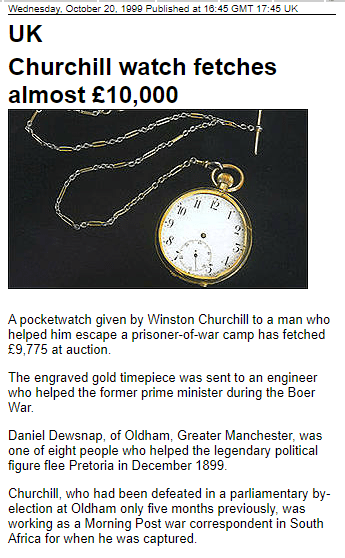
Churchill was alone and on the run in Africa, which must have been the last place on earth that he expected to meet someone from Oldham. But for three days he was hidden in a coal mine, and the mining engineer who helped to lower him into his hiding place was Oldham native Dan Dewsnap. Churchill later described how Mr. Dewsnap locked his hand “in a grip of crushing vigour” and said, “They’ll all vote for you next time.”

Dewsnap was right. Churchill’s escape made him a national hero and, although he stayed in South Africa until the following summer, the incident was enough to ensure his celebrity status. He returned to Oldham to speak on 25 July 1900 and was greeted by brass bands and massed crowds: “Oldham almost without distinction of party accorded me a triumph. I entered the town in state in a procession of ten landaus, and drove through streets crowded with enthusiastic operatives and mill girls. I described my escape to a tremendous meeting in the Theater Royal.” There is an interesting footnote to the Dewsnap story here, for when Churchill mentioned the role played in his escape by this son of Oldham “the audience shouted: ‘His wife’s in the gallery!'”
This warm reception may have been instrumental in persuading Churchill to stand for Oldham again in the general election of October 1900. The archives show that he had been approached by the Southport Conservative Association and asked to stand as their candidate as early as April 1900. But in a letter to his mother from South Africa in May he stated that “I have very nearly made up my mind to stand again for Oldham. They have implored me not to desert them.” Churchill had lost by less than 1500 votes in 1899 and with his newfound fame he clearly felt that he had better chance than in the year before.
This time round the other Conservative candidate was a stockbroker called Charles Crisp. James Mawdsley had been forced to retire from political life after an unfortunate accident. According to Churchill he was a very heavy man who “had taken a bath in a china vessel which had broken under his weight,” inflicting severe injuries.
Churchill clearly took this campaign very seriously. Writing to his mother in August, he explained that he had turned down other speaking engagements because he felt that he must concentrate all his efforts upon the campaign: “I must be about Oldham everyday, and it would be so foolish to throw away any chance of winning the seat merely for the purpose of pleasure.” By 21 September he was once again imploring Lady Randolph to come and help him campaign. Mr. Crisp’s wife was apparently “indefatigable, going about trying to secure voters and generally keeping the thing going.” It seems to have been the expected thing for each candidate to have the support of a woman, and without a wife, Churchill had to turn to his famous mother.
Churchill’s campaign was also greatly helped by Joseph Chamberlain, Secretary of State for the Colonies and one of the most famous Conservative politicians of the day. For most of his career Churchill would find himself at odds with Joseph Chamberlain, and indeed his son Neville; but for now they were allies and Chamberlain traveled to Oldham to speak on Churchill’s behalf.
The polling of 1900 has become known as the Khaki Election because it was conducted against the backdrop of apparent British success in the Boer War. This put the Conservative Government in a strong position and allowed Churchill to exploit his South African experiences to the full. In his printed address to the electors of the Borough, Churchill appealed to the growing mood of patriotism, asking the voters to set their seal “to the work which has been nobly done by the soldiers in South Africa, by proclaiming to the jealous nations of Europe that England believes in the justice of her cause and is determined to persevere.”
The Oldham result was declared on 1 October. It had been a close call. The Liberals retained their overall majority, but enough Liberal voters had given Churchill their second vote to get him elected as the town’s second MP. Churchill’s long career in the House of Commons had begun.
Letters of congratulation poured in. Lord Salisbury, the former Conservative Prime Minister wrote, “I can well understand that your African performances, of various kinds, should have had a perceivable effect on the minds of the electors of Oldham. They have always been a difficult constituency to tackle.”
Churchill launched into his parliamentary career with great relish. But what sort of local MP was he? The truthful answer is probably that he was a remote figure. His base was certainly London and there are signs that the constituency organization was fairly primitive. In December 1903 Churchill received a letter from Mr. Ware, the organizing secretary and registration agent of the Oldham Conservative Association. The contents give an insight into the dismal working conditions in the Party’s office:
“There is neither warmth nor comfort in the place. Through the recent frost one of my clerks is dead (pneumonia) and the other has acute bronchitis, & the two illnesses can only be attributed to the absence of any fire or warmth in the office, and to general damp, dark, unsanitary condition.”
Four days later the other clerk had died, forcing Mr. Ware to reflect that, “It is a co-incidence that both my clerks should have been removed by the hand of death within a week from one another.” On the positive side, however, he observed that, “I think that our office will be conducted with more discipline, decorum, and efficiency than what has been possible with old men in the office who have been accustomed to a ‘set’ style, and think that the world (politically) is coming to an end if one attempts to alter it.”
Churchill’s position did involve him in a certain amount of local patronage. There were requests for references from those wanting to be local tax collectors or sanitary inspectors, and requests for support and money from local institutions. Perhaps the most amusing of these is the letter from the Oldham Temperance Mission asking for a donation towards the cost of some building work. Someone, possibly Churchill himself, has underlined one of the key phrases in the letter: “The only plank of our platform is that the members must be teetotal.” We can be sure that this was one local group which did not ask Churchill to become its patron.
The main development during Churchill’s time at Oldham was his breach with the Tory Party which led to his resigning the seat. The debate involving tariffs at the beginning of the last century can be likened to the current debate over Europe: it aroused strong feelings and cut across party lines. A wing of the Conservative Party, under Joseph Chamberlain, wanted to introduce tariffs or taxes on imported foods and goods, while others like Churchill defended the Victorian policy of Free Trade.
It is not clear why Churchill embraced Free Trade so wholeheartedly. In part it must have been principle. But it also provided him with a cause to champion, and a useful means of getting noticed within the House of Commons. In Oldham it quickly led to a breach with the majority of his own supporters. By 1903 the grass roots of the Conservative Party were clearly lining up behind Chamberlain, and Oldham was no exception. In August 1903 the Marlborough Conservative Club, in the Clarkesfield Ward on Pitt Street East, passed a resolution protesting against Churchill’s conduct “in committing himself to a hostile attitude towards the Fiscal Reform Scheme.” And in December Churchill and Earl Lytton appear to have been physically prevented from addressing a meeting at the North Chadderton Conservative Club. The general secretary subsequently sent an apology for this “uncourteous treatment” which he blamed on “a few of the least intelligent members, simply the riff raff of the club.”
The matter had come to a head in October when the Oldham Conservative Association had reacted angrily to a letter by Churchill in which he described Joseph Chamberlain as a “quack.” Samuel Smethurst, vice chairman of the local association and one of Churchill’s few supporters within the party, wrote that his letter “seems to have had the effect of a spark laid to gunpowder” and added, “Frankly I think your chance now at the next election seems small, and if you are to find your platform it will have to be on the Liberal side.”
On 28 December 1903, the General Purposes Committee of the Oldham Conservative Party formally passed a motion of no-confidence in Winston Churchill. This was ratified by the Executive Committee in January 1904 and Churchill ceased to be the official Conservative candidate. He could have resigned, forcing an immediate by-election, but after considerable negotiation behind the scenes it was decided that this was in nobody’s interest.
Thus Churchill remained MP for the borough until the general election of 1906. But his interests were now increasingly elsewhere. On 31 May 1904 he completed his break with the Conservative Party, dramatically crossing the floor of the House of Commons to take up a seat on the Liberal opposition benches next to the radical Lloyd George. Just days before he had been selected to stand at the next general election as the candidate for North-West Manchester. Politically and geographically he had moved down the road.
It turned out to be a good move. He was swept to victory in Manchester in 1906 and became a junior minister in the Liberal Government. From there he rose rapidly, entering the Cabinet as President of the Board of Trade in 1908, and later serving as Home Secretary and First Lord of the Admiralty. But his career was not all plain sailing. He was forced to resign from the Government after the failure of the Dardanelles campaign in 1915, and spent most of the 1930s out of office. But by then he was a national figure.
There can be no doubt that the summer of 1940 was Churchill’s “Finest Hour.” He replaced Neville Chamberlain as Prime Minister on the day that Hitler began his blitzkrieg in Western Europe. Within two months Belgium, the Netherlands, Luxembourg and France had capitulated, and the British Expeditionary Force had been evacuated from Dunkirk. The prospect of a German invasion became a reality, and the Churchill Papers include copies of intelligence reports describing the build-up of enemy forces across the Channel. The might of the Luftwaffe was unleashed as the country faced the Battle of Britain, and then the Blitz.
Churchill provided hope and inspiration. Phrases such as “Never in the field of human conflict was so much owed by so many to so few” assumed a great psychological importance. Churchill did more than just talk. He toured the bomb-damaged towns and cities, and took a keen interest in any measure that might improve morale.
It seems appropriate that the borough of Oldham, Churchill’s first constituency, was also the first of many towns and cities formally to recognise his amazing achievements. Churchill was elected a Freeman of Oldham in 1941, when the outcome of the war was still far from certain. He never came to collect the Freedom Scroll, although he did visit Oldham briefly in June 1945 during his election tour.
In November 1964 Churchill was ninety years old. It was clear that he would not live much longer. Telegrams of congratulation poured in from throughout the United Kingdom and around the world. The mayor of Oldham sent one on behalf of all the townspeople, “whose parents launched you on [y]our parliamentary career.”
What can we conclude about Churchill’s time at Oldham? For him it was very much the first rung on the ladder. Oldham got Churchill into politics and into Parliament. It gave him his first experiences, not only of campaigning and public speaking but also of political in-fighting and maneuvering. It may also have given him his first real insight into the lot of the ordinary working man, and so contributed to his move towards Liberalism. In later life Churchill looked back fondly on his time at Oldham, remembering “the warm hearts and bright eyes of its people,” and writing that “No one can come in close contact with the working folk of Lancashire without wishing them well.” I am sure that Oldham has come to regard Churchill in similarly nostalgic terms. The records reveal a less rosy but far more lively and interesting reality.
 Keeper of the Family
i found this article interesting and enlightening.
LikeLike
I am related to Dan he was my great grandfather on my great Grandfather on my Mums side currently looking into his history
LikeLiked by 1 person
Hi Raymond, I’d love to hear the results of your search and how we might be connected! 😁
LikeLike